
The 2026 Parent’s Blueprint: Empowered Intuition Through Data Integration
How TinyNestHub transitions from monitoring routines to creating purposeful, proactive parent-child environments.
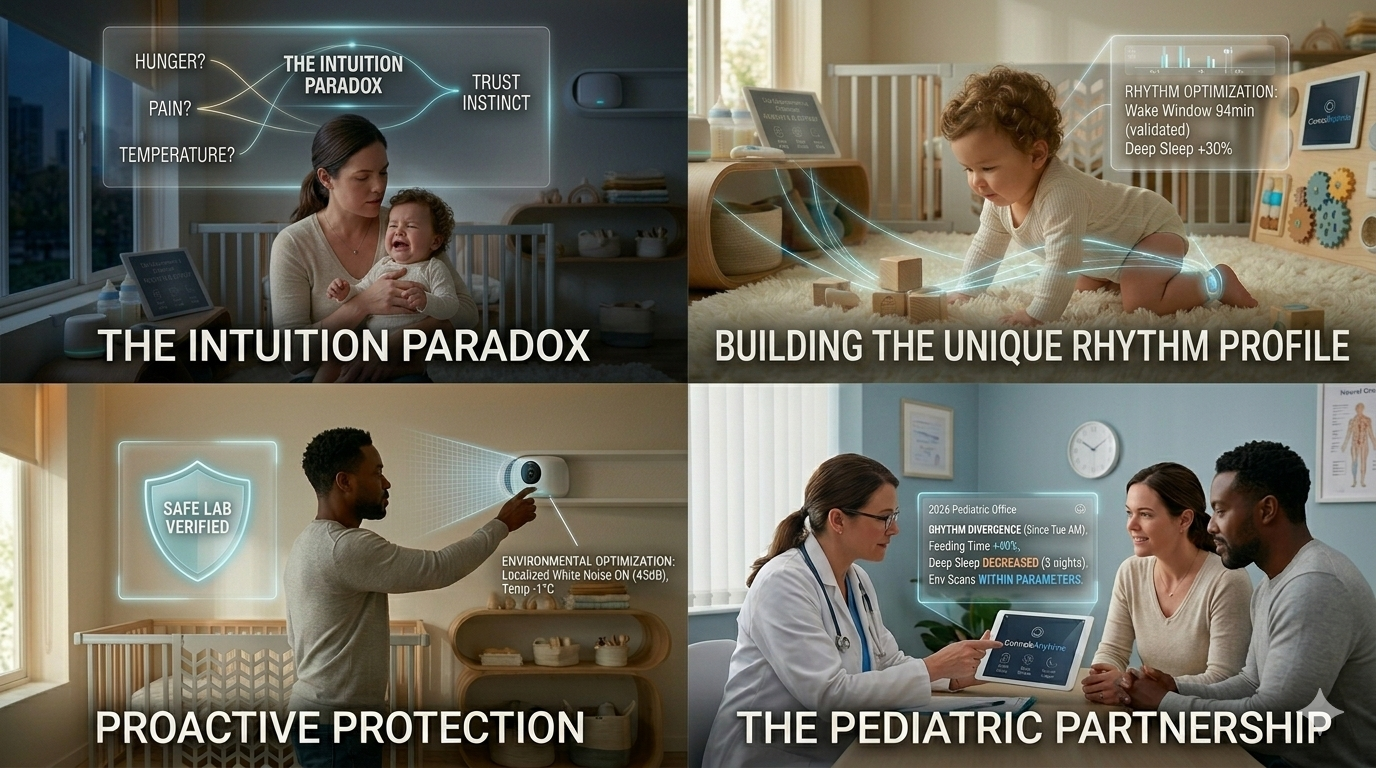
The Intuition Paradox
Every new parent is told, “Trust your instinct.” It’s profound advice, but also intensely cruel, because that advice is given during the two most stressful, sleep-deprived years of their life.
When you are monitoring a one-month-old on your own (perhaps as the protector in an unexpected situation), your primal intuition is screaming “PROTECT.” But your analytical brain is asking: Is that cry hunger or pain? Was their breathing always that shallow? What temperature is this room, really?
The intuition paradox is that the sheer volume of “noise” generated by anxiety, exhaustion, and conflicting external advice drowns out the very signals a parent is told to follow.
The 2026 TinyNestHub Blueprint resolves this paradox. We don’t ask you to ignore your intuition. We provide a clean data framework that validates it. We use non-invasive environmental and biometric sensors not to replace your observation, but to provide an analytical context for it.
“The modern, tech-driven toolkit of 2026 isn’t designed to replace your intuition; it is designed to filter out the noise so your innate protective signals become powerful, precise, and proactive.”
Building the “Unique Rhythm” Profile
Parenting by the old, generic checklist—”Nap every two hours,” “Feed 4oz,” “Diaper change frequency X”—ignores the fundamental truth that babies are not standardized algorithms. They are delicate biological systems with unique, individual rhythms.
By integrating data, the 2026 parent moves from chasing benchmarks to anticipating patterns. By understanding how environmental factors and products affect these rhythms, we can eventually help you select the *right* tools—an essential step for the future offerings at babeshop.com.
The Blueprint in Action: Identifying the Sleep Window
A standardized chart might tell you a four-month-old needs 14-17 hours of sleep. If you follow that blindly, you are often trying to *force* a nap on an overtired baby, creating a high-stress cycle.
With TinyNestHub data integration, you aren’t guessing. You are observing your baby’s Unique Rhythm Profile. You might discover: ‘Nap attempts made after exactly 94 minutes of wake-time result in 70% faster onset-to-sleep and 30% longer SWS (Deep Sleep) durations.’
Data reveals that your specific baby’s “wake window” isn’t the generic two hours; it’s 94 minutes. This single data-driven insight transforms nap time from a struggle into a peaceful, predicted routine.
Proactive Protection: From Response to Control
The ultimate goal of 2026 parenting is to transition from a reactive protector to a proactive one. You are not just a *responder* to distress; you are the purposeful controller of the distress signals themselves.
The ControlAnytime Safety Lab identifies unseen toxins and environmental triggers. But a secure environment is more than just clean; it’s optimized. Future products launched on babeshop.com must undergo this same verification process.
The “Optimum State” Feedback Loop
When your TinyNestHub detects an emerging distress pattern (like environmental temperature rising or biometric agitation pre-dating a cry), it triggers a Purposeful Environment sequence. This sequence—which might subtly lower the LED lighting color temperature to 2700K and activate targeted, localized 45dB white noise—is designed not to solve the problem for you, but to *stabilize the environment* and the baby while you respond.
Tech is used as a shield, providing critical context and environmental correction so that when you arrive, you are not stepping into chaos. You are entering a data-stabilized environment where you can deploy your amplified intuition to determine the specific human intervention required.
Validation and the Pediatric Partnership
The most powerful benefit of a personalized data framework is the confidence it provides. The exhausted, intuitive “feeling” that something is wrong is now a precise, verifiable observation.
This data integration transforms the parent’s relationship with their pediatrician. Instead of presenting subjective reports—”They seem fussy and aren’t sleeping well”—the 2026 parent presents objective data streams.
“Patient Rhythms: Average time-to-feed +40% (since Tuesday AM). Deep sleep duration DECREASED for three consecutive nights. Environmental/Toxin scans: WITHIN PARAMETERS.”
This precise communication allows the pediatrician to diagnose faster and with higher accuracy. The parent is validated as the ultimate source of data, becoming an active, credible partner in their baby’s healthcare.
Conclusion: Human Intuition, Amplified
We must reject the idea that technology diminishes the role of the parent. The 2026 TinyNestHub Blueprint proves the opposite.
By filtering out the analytical noise and validating intuitive signals, tech allows the modern parent to provide the 90% that data *cannot* give: the deep tactile connection, the soothing voice, the purposeful presence, and the unwavering love. Data is not the end goal; it is the sturdy scaffolding that allows purposeful intuition to thrive, creating a safe, predictable, and derply connected environment where both the baby and the parent can achieve their optimal state. This is the foundation upon which babeshop.com will build its future curated offerings.